
Shenzhen Antek Optic Technology Co.,Ltd +8615914137519 sales@antek-optic.com
When planning an FTTH project, subscriber count is often one of the first numbers to look at.
For example, a project may have 1,000 potential subscribers. It may seem straightforward to calculate the number of PON ports required based on the expected split ratio.
But in practice, subscriber count is only one part of the picture.
When selecting OLTs, ONUs and related equipment for an FTTH project, several other factors can affect the equipment requirements.
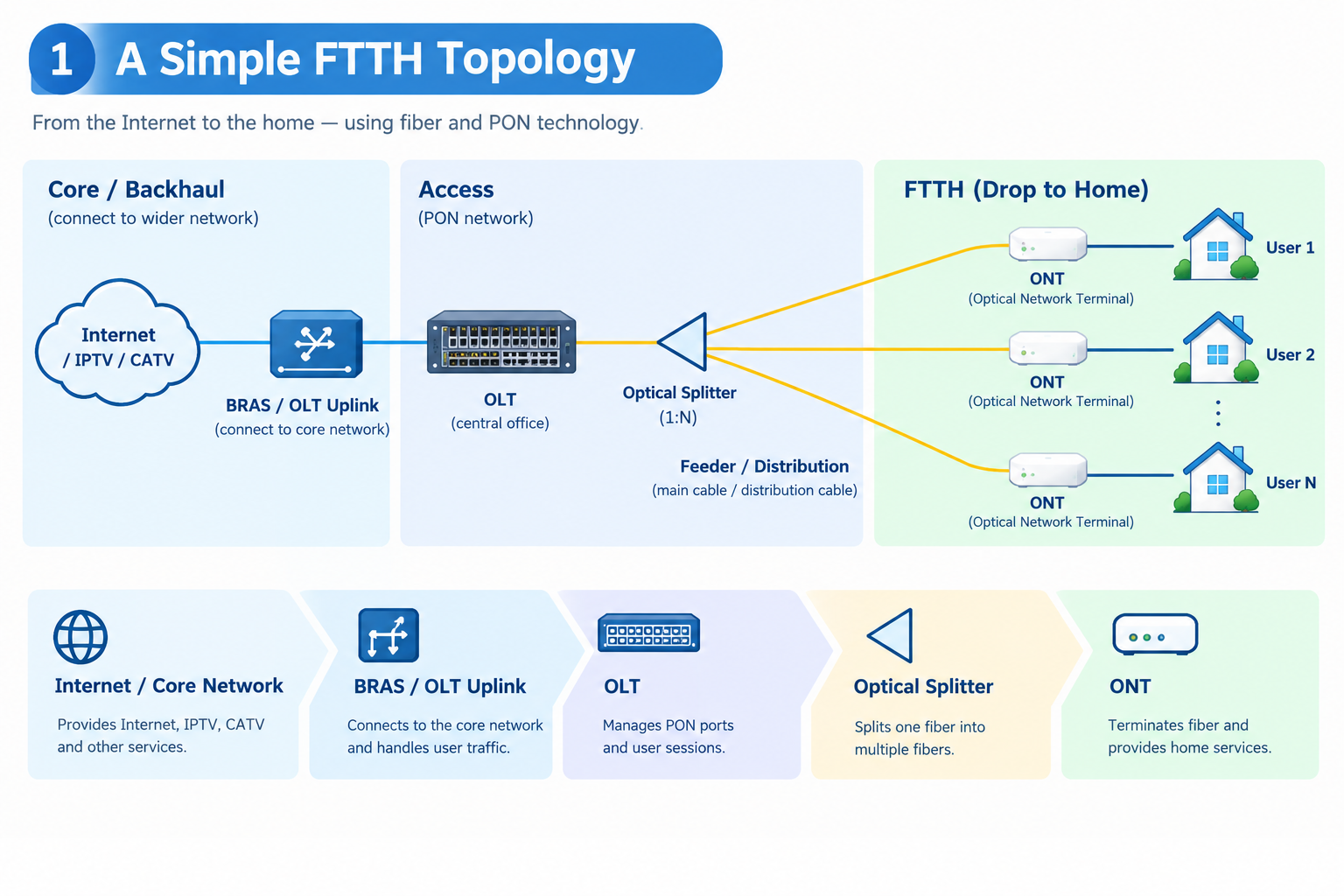
Knowing the number of subscribers gives us an initial idea of the required PON capacity.
However, 1,000 subscribers do not necessarily mean that all 1,000 users will generate the same traffic demand at the same time.
A residential FTTH network may serve users with different service packages and different usage patterns.
For this reason, it is useful to consider not only the total number of subscribers, but also the expected traffic demand and usage patterns when evaluating equipment requirements.
Average traffic does not always tell the whole story.
In many residential networks, traffic demand can increase significantly during certain periods of the day.
This is why looking only at the maximum theoretical capacity of an OLT or PON port may not provide a complete picture of how the equipment will be used in a real deployment.
For equipment selection, understanding the expected traffic profile can help avoid simply choosing equipment based on subscriber numbers alone.
The split ratio is another important consideration.
For example, a PON port may serve different numbers of ONUs depending on the network design and the optical distribution architecture.
A higher split ratio can allow one PON port to serve more subscribers, but it also needs to be considered together with the available optical budget and the requirements of the deployment.
Therefore, the question is not simply:
“How many subscribers can one PON port support?”
It is also:
“What split ratio is appropriate for this particular project?”
The PON access side is only one part of the equipment consideration.
An OLT also needs sufficient uplink capacity to connect to the upstream network.
For this reason, when comparing different OLT models, it is useful to look beyond the number of PON ports and consider the uplink interfaces and overall capacity of the equipment.
A larger number of PON ports does not automatically mean that a particular OLT is the right choice for every project.
FTTH networks often grow over time.
A project that starts with several hundred subscribers may eventually expand to several thousand.
When selecting equipment, it can therefore be useful to consider not only today's requirements, but also the expected direction of future expansion.
The goal is not necessarily to overbuild from day one.
Instead, the equipment should provide a practical balance between current requirements, investment and future expansion.
For an FTTH project, there is rarely one number that determines the right equipment.
Subscriber count, traffic demand, split ratio, optical requirements, uplink capacity and future expansion can all influence the selection.
At Antek Optic, our focus is on the equipment side of FTTH projects.
Based on a customer's project requirements, we can help evaluate suitable OLT, ONU and related optical equipment options from our product range.
We believe a good equipment solution should start with understanding the customer's actual requirements — rather than simply recommending the product with the largest capacity.
If you are planning an FTTH deployment, expansion or equipment upgrade, you are welcome to share your basic project requirements with us. We can discuss the relevant equipment options and see what fits your application.